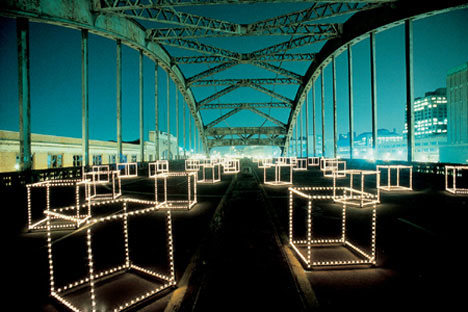
This light graffiti by Eric Staller caught my attention because it does not look like a conventional light graffiti. Staller chose to present the light in the form of a simple 3D shape, the cube. The edges of the cube are formed by smaller, circular shapes, which contrasts the straight lined shapes. Repetition is one of the main points of this piece, as the cube shape is repeated numerous times with variation in size and orientation to create a feeling of depth and perspective, and to keep the piece from looking monotonous. Repetition is also seen with the small, circular light points. Contrast in value can be seen in the lower part of the piece, as the bright light contrasts with the dark ground. Harmony is found in the background hues of blue, green and yellow and lights from the cityscape background add an appealing effect. The lines of the bridge in the background go well with the lines of the cubes. How the artist decided to make use of the key elements of shape, line and repetition makes this light graffiti unique and original.

At a first glance, this piece by Mirko Reisser (more popularly known as DAIM) does not look like street graffiti, but more like vector art, doesn't it? DAIM is known for his clean and precise 3D-style graffiti art. This piece, like many of his other pieces, explores creative 3-dimensional shapes and a mixture of straight and curved, thick and thin lines in many oblique directions. This creates an abstract and indulging feeling with the use of asymmetrical balancing, yet a sense of unity as, however complex it may look, most of the shapes seem to originate from one area. Complimentary colours of blue and orange are the main hues of the piece, along with additional black, grey and white tones. The use of gradation and shadowing makes the overall texture look smooth and hard. DAIM's style as seen in this piece shows a very refined graffiti art that cannot be produced by any other artist.
COMPARISON OF LIGHT AND TRADITIONAL
Light graffiti and traditional graffiti are similar in the way that they focus on the elements of line and shape to create a sort of abstract piece of art. A key point in both styles of art is to have your surroundings as your canvas. Both require precision and skill to achieve. However, although they are both classified as graffiti, light is significantly different from traditional in that it is more of a photographic art and relies on the camera as much as visual ability, yet in most cases, traditional graffiti seems more complex. To the naked eye, light graffiti is gone in a flash, but the result is seen on photo, whereas traditional graffiti is permanent art and may be considered vandalism in some cases.


0 comments:
Post a Comment